


The difference between the grating scale and magnetic scale of CNC bending machine

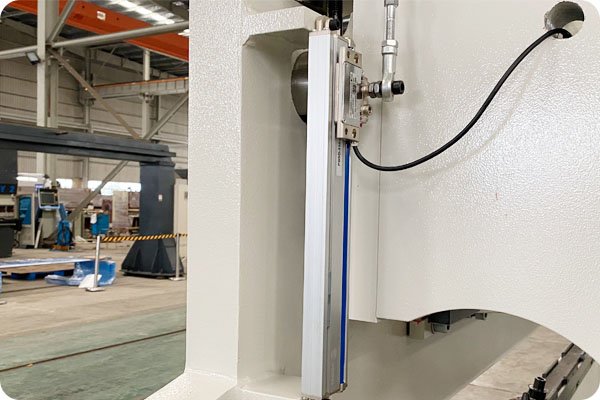
In the displacement measurement system of the bending machine, grating scales and magnetic scales each have their advantages and disadvantages. The selection should be made based on a comprehensive judgment of factors such as the working environment of the bending machine, accuracy requirements, and maintenance costs. The following is a detailed comparative analysis from the aspects of core characteristics and applicable scenarios:
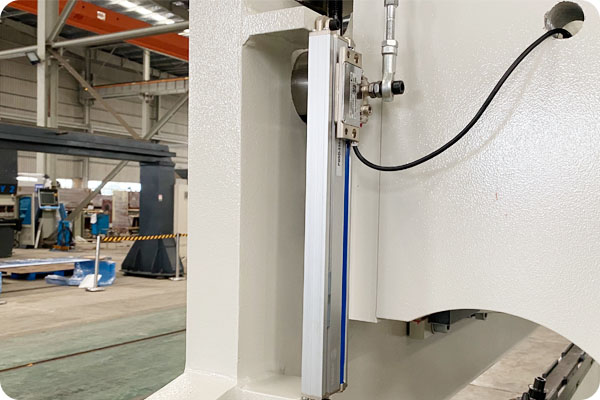
Compatibility Analysis for Press Brakes
The operating environment of press brakes is typically characterized by high vibration, high levels of oil, metal debris, and large temperature fluctuations. Furthermore, the core requirement of “stable measurement of slide displacement to ensure bending angle accuracy” must be met. Considering these characteristics, the compatibility differences are as follows:
1. Environmental Adaptability: Magnetic Scales Prefer Advantages
When a press brake is operating, bending metal sheets generates debris and coolant splashes. The slide movement is accompanied by vibration, and the machine body is susceptible to oil contamination.
The optical principle of an optical scale relies on an unobstructed optical path. Oil and dust adhering to the grating surface can obstruct light, leading to signal loss or error. Vibration can also cause misalignment of the grating stripes, directly affecting accuracy. Using an optical scale requires an additional sealed protective cover (such as a stainless steel telescopic cover), but contamination cannot be completely eliminated, and maintenance is frequent (weekly cleaning is required). The electromagnetic signal of a magnetic scale is unaffected by oil, dust, and metal debris, and it won’t interfere with the magnetic head’s sensing. Its structure is vibration-resistant (the magnetic strip is securely fixed, and the head and stripe are non-contacting). It requires no complex protection and can withstand the harsh environments of press brakes, extending maintenance cycles to several months or even six months.
2. Accuracy Requirements: Magnetic scales are sufficient for most applications, while optical scales are preferred for high-precision applications.
The accuracy requirements of press brakes primarily depend on the type of workpiece being processed:
General sheet metal parts (such as chassis and cabinets) typically require bending accuracy of ±0.1-0.3mm, which is fully met by the ±5-10μm measurement accuracy of a magnetic scale (translating to a bending angle error of within ±0.1°).
High-precision bending (such as aerospace and automotive precision parts) requires displacement control within ±0.05mm. The ±1-5μm accuracy of an optical scale is more advantageous, but it must be combined with strict protection (such as a fully sealed shield and air purge device), otherwise it is prone to failure due to environmental contamination. 3. Jiangsu Kraus Machine Tools has consistently used Fagor linear scales. Fagor linear scales are high-precision measurement feedback devices manufactured by Fagor Automation of Spain. The company has been producing linear scales and encoders since 1975, and their products have become competitive in the machine tool industry. The following is a detailed description:
Applications: Commonly used in closed-loop servo systems in CNC press brakes, they can measure linear or angular displacement, monitor tool and workpiece coordinates, and compensate for tool motion errors. They are also widely used in measurement and production equipment in the semiconductor industry, PCB assembly machines, high-precision machine tools, measuring machines, comparators, measuring microscopes, and other applications requiring high-precision measurement.
Product Type:
Glass linear encoders: Use transmitted light through the scale and scanning grating to generate signals, and can measure lengths up to 3040mm.
Steel tape linear encoders: Use reflected light through the scale and scanning grating to generate signals.
Product Series Features: Taking the 3-series linear encoders G3-FS, S3-FS, and SV3-FS as an example, this series of encoders complies with multiple functional safety standards for machinery and electronic equipment, and has been audited and certified by TÜV SÜD. Leveraging patented optical technology, redundant absolute position information is simultaneously acquired for safer operation. Utilizing 3STATECH technology, the encoders effectively resist contamination in harsh environments and can detect “unacceptable” data using a third-state signal. Furthermore, these encoders offer high repeatability and robustness.
Output Interface and Data Format: Taking the SA series optical scale as an example, it uses an SSI interface to output data. The factory default configuration includes two data formats: 32-bit binary code (without checksum) and 26-bit Gray code (with parity check).
GV magnetic scales utilize magnetostrictive or magnetoresistive effects to achieve displacement measurement. The scale has magnetic graduations arranged in a certain pattern. When the magnetic head moves relative to the scale, the sensing elements in the head detect the changes in the magnetic field, generating corresponding electrical signals. By processing and analyzing these signals, the position of the head relative to the scale can be determined, enabling precise measurement of object displacement.
Applications
Machine Tool Processing: On lathes, milling machines, grinders, and other machine tools, GV magnetic scales can be used to accurately measure the displacement of the worktable or tool, enabling precise machining control and improving the dimensional accuracy and surface quality of machined parts. Automated production line: On an automated production line, it can be used to detect the position and movement distance of workpieces, realize automated material transportation, positioning and assembly operations, and improve production efficiency and product consistency.